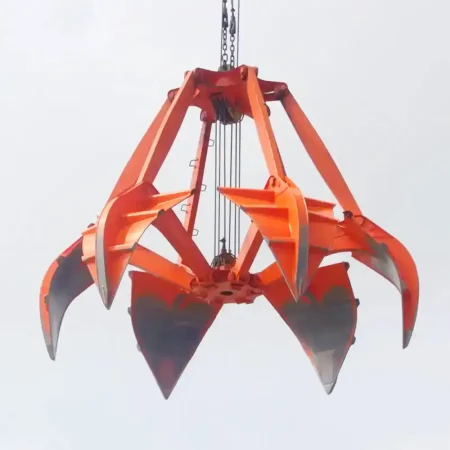
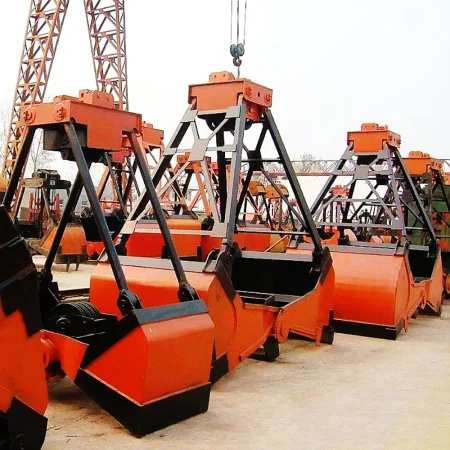
A grab is a special crane tool for handling dry‑bulk goods. It forms a material‑holding space via two or more operable bucket jaws. Jaws close inside the pile to capture materials during loading and open while suspended to discharge cargo. Jaw movement is normally driven by the hoisting wire ropes of the crane.
A grab is a specialized tool used by cranes to handle dry bulk cargo. It consists of two or more openable bucket-shaped jaw plates that together form a material-holding cavity. During loading, the jaw plates close while embedded in the material pile, drawing material into the cavity; during unloading, the jaw plates open while suspended above the pile, releasing the material. The opening and closing of the jaw plates is generally controlled by the wire rope of the crane’s hoisting mechanism. Grab operation eliminates heavy manual labor, achieves high loading/unloading efficiency, and ensures safety, making it the primary dry bulk cargo handling tool at ports. Depending on the type of cargo handled, grabs can be classified as ore grabs, coal grabs, grain grabs, timber grabs, and so on.
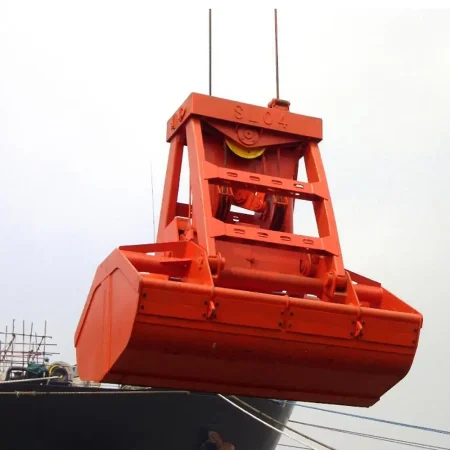
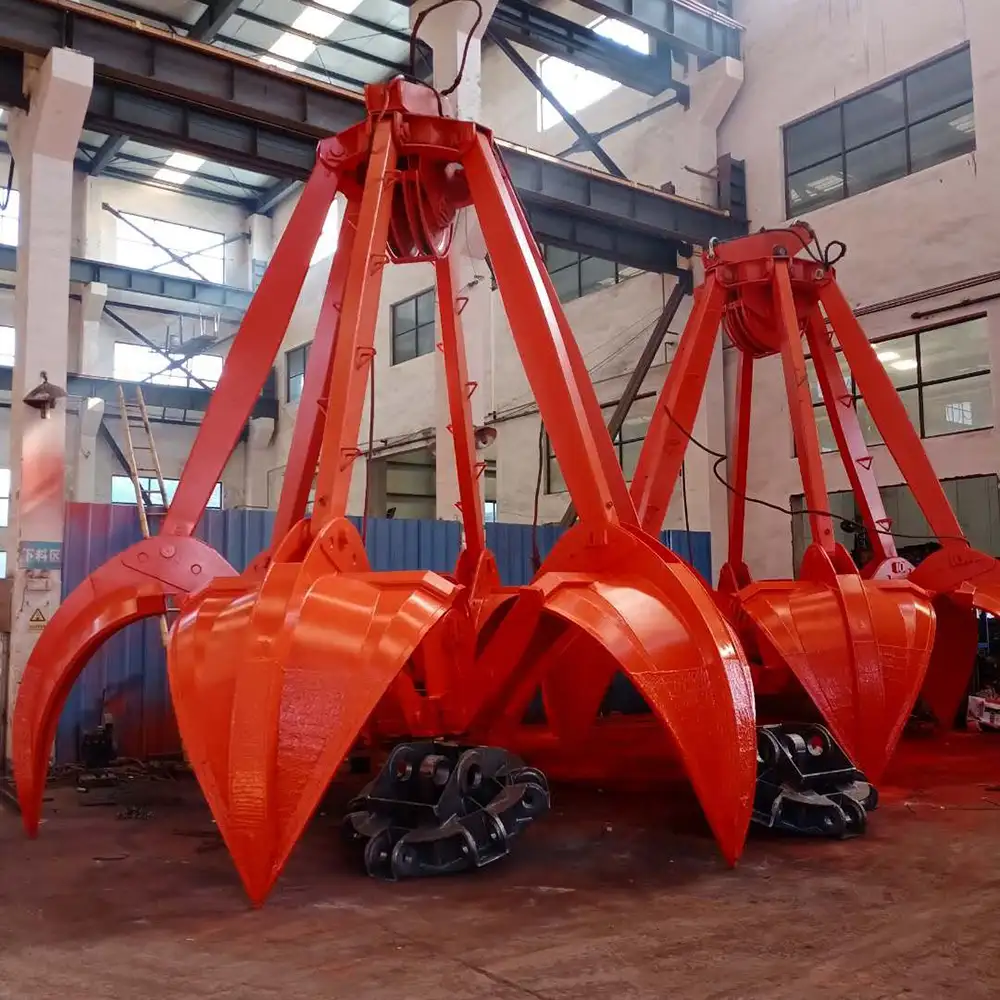
By shape, grabs are divided into clamshell grabs and orange-peel grabs. The former consists of two complete shovel buckets, while the latter is composed of three or more jaw plates.
By drive method, grabs fall into two major categories: hydraulic grabs and mechanical grabs.
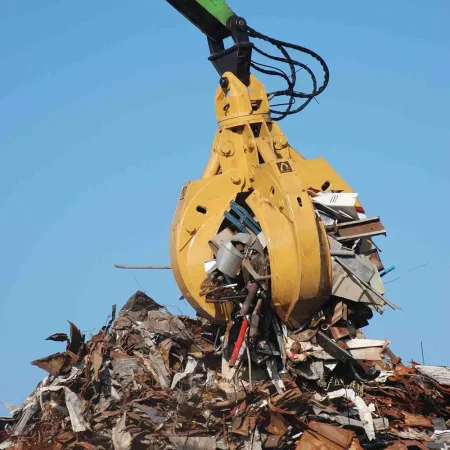
A hydraulic grab is equipped with its own opening-and-closing structure, generally driven by hydraulic cylinders. A hydraulic grab composed of multiple jaw plates is also called a hydraulic claw. Hydraulic grabs are widely used in hydraulic specialized equipment, such as hydraulic excavators and hydraulic lifting towers.
Hydraulic grabs belong to the category of hydraulic structural component products. They are composed of hydraulic cylinders, buckets (jaw plates), connecting columns, bucket lug plates, bucket lug bushings, bucket teeth, tooth adapters, and other spare parts. Therefore, welding is the key manufacturing process for hydraulic grabs, and welding quality directly affects the structural strength and service life of the grab. In addition, the hydraulic cylinder is also a critical drive component.
Hydraulic grabs are specialized industry equipment accessories that require dedicated equipment for efficient and high-quality operation, such as CNC plasma cutting machines, bevel edge milling machines, plate rolling machines, welding positioners, boring machines, and hydraulic test benches.
Excavator-Specific Hydraulic Grabs — These are divided into rotating and non-rotating types. Non-rotating grabs use the oil circuit of the excavator’s bucket cylinder, requiring no additional hydraulic valve block or pipelines; rotating grabs require an additional set of hydraulic valve blocks and pipelines for control.
Applicable scenarios for excavator-specific hydraulic grabs:
A mechanical grab is not equipped with its own opening-and-closing structure and is typically driven by external force via ropes or linkages. By operational characteristics, it can be divided into double-rope grabs and single-rope grabs, with the double-rope grab being the most commonly used.
Single-Rope Grab — The supporting rope and closing rope are the same wire rope. Through a special locking device, the wire rope alternately serves as the supporting and closing function. The winding mechanism of a single-rope grab is relatively simple, but its productivity is low, so it is rarely used in high-volume loading and unloading operations.
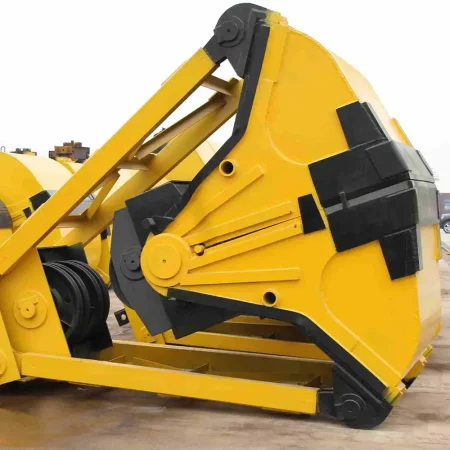
Grabs are further classified by the bulk density of the material being handled into three types: light-duty (e.g., for grain), medium-duty (e.g., for sand and gravel), and heavy-duty (e.g., for iron ore). By the number of jaw plates, they are divided into double-jaw grabs and multi-jaw grabs, with the double-jaw grab being the most common. For large lumps of ore, iron scrap, and steel scrap, multi-jaw grabs are preferable because their multiple claws and sharp cutting edges make it easier to penetrate the material pile, achieving better grasping results. There is also a scissor-type grab (Figure 2) modeled on the principle of scissors. Its gripping force gradually increases as the jaw plates close, reaching a maximum at the end of closure; its bucket mouth opening and material coverage area are also larger than those of conventional grabs, improving grasping capacity and facilitating the cleaning of stockyards and ship holds. However, for large-lump materials, its initial gripping force is small, resulting in poorer performance.
Double-Rope Grab — It has a supporting rope and a closing rope, wound respectively around the drums of the supporting mechanism and the closing mechanism. Figure 1 illustrates the working process of a double-rope grab: (a) the supporting rope and closing rope descend simultaneously, the bucket mouth opens and inserts into the material pile; (b) the closing rope is tensioned, the jaw plates close and grasp the material; (c) after the grab is closed, the supporting rope and closing rope rise simultaneously; (d) the supporting rope remains stationary while the closing rope descends, the bucket mouth opens and discharges the material. Double-rope grabs offer reliable operation, simple handling, and high productivity, and are therefore widely used. Using two sets of double ropes results in a four-rope grab, whose working process is identical to that of a double-rope grab.
A grab is a dedicated attachment for cranes to handle dry‑bulk cargoes. It consists of two or more openable and closable bucket‑shaped jaws that form a material‑holding cavity. For loading, the jaws close within the material pile to trap bulk materials inside the cavity. For unloading, the jaws open in a suspended position above the stockpile, allowing the materials to fall freely. The opening and closing motions of the jaws are generally controlled by the wire ropes of the crane hoisting mechanism.
The 4‑rope grab is mainly used in conjunction with overhead travelling cranes to grab various loose piled materials and perform operations such as loading, unloading, stockpiling and feeding.
According to grab volume and bulk density of the handled materials, grabs are generally classified into four categories: light‑duty, medium‑duty, heavy‑duty and extra‑heavy‑duty.
The overhead travelling crane is equipped with two sets of double‑rope drums. Each drum outputs two groups of wire ropes. One group of two ropes is fixed to the inclined shells (lifting lugs and tie‑bolts) at both ends of the grab balance frame and serves as support ropes. The other two ropes act as opening‑closing ropes. These ropes run through rope guard wheels, head pulleys and lower cross‑beam pulleys to form pulley blocks, which control the opening and closing movements of the grab.
At the start of operation, the support ropes lift the grab to a proper height, then the opening‑closing ropes are lowered. The self‑weight of the lower cross‑beam forces the bucket to swing open around the main shaft of the lower beam. The grab reaches its maximum opening stroke when the stoppers on two ear plates collide. During opening, the centre‑to‑centre distance between the upper‑beam pulleys and lower‑beam pulleys increases. The support ropes are then lowered to place the fully‑opened grab onto the material pile. The opening‑closing ropes are subsequently hauled in to restore the original centre distance of the upper and lower beam pulleys, completing the material‑grabbing cycle. Once the bucket is fully loaded, the support ropes and opening‑closing ropes are hoisted simultaneously to lift the grab. The crane transports the grab to the discharge location, where the bucket opens to unload materials.


Discuss your material handling requirements directly with our engineers. We will help you evaluate the right equipment solution based on your application, capacity, and site conditions.
Tell us your material handling requirements. Our engineering team will provide a customized solution and quotation.